Article
Nov 26, 2025
Discover Quality Clouds’ key takeaways from Dreamforce 2025, from Salesforce’s agentic enterprise vision to the future of real-time AI governance.
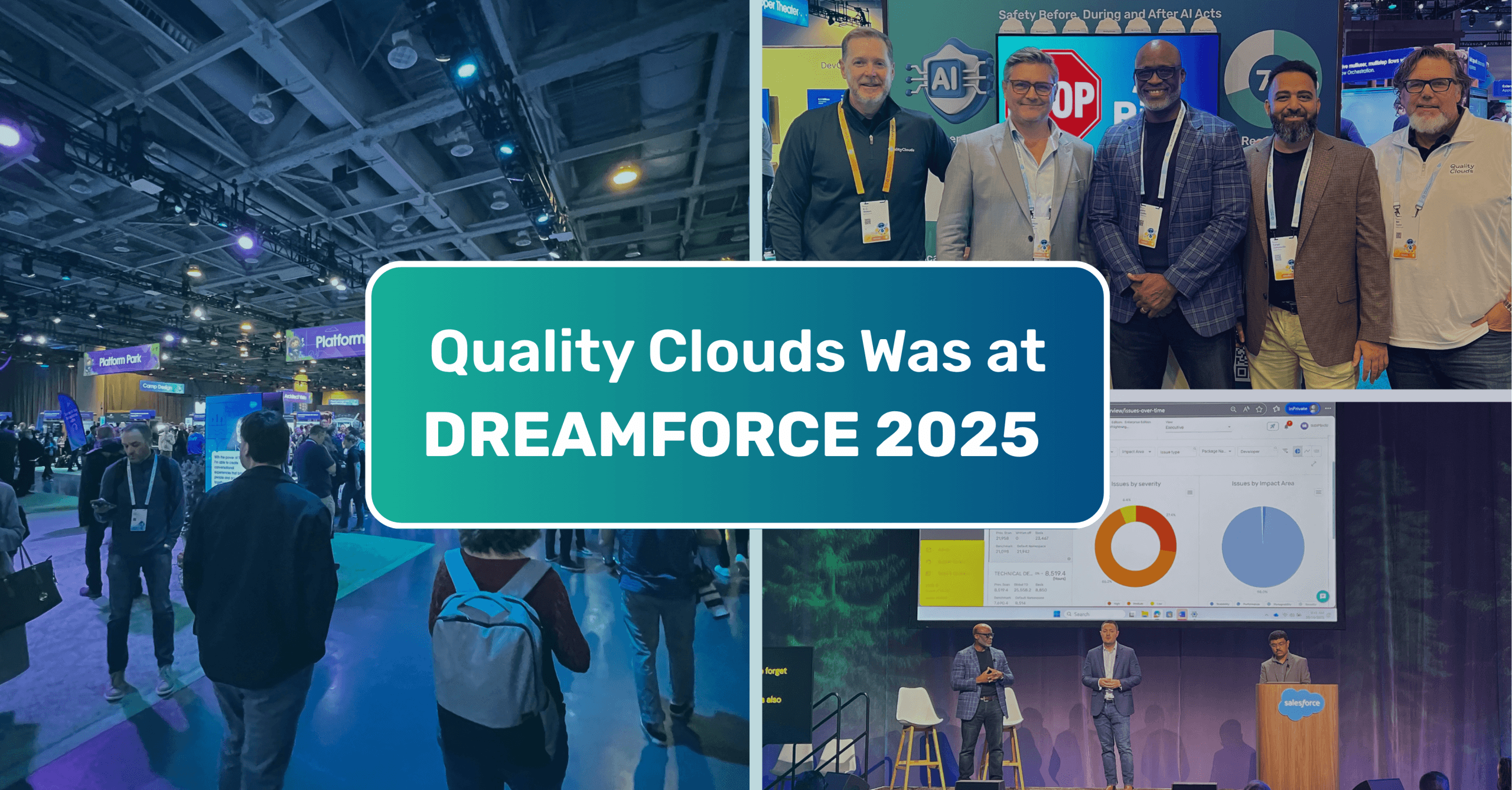
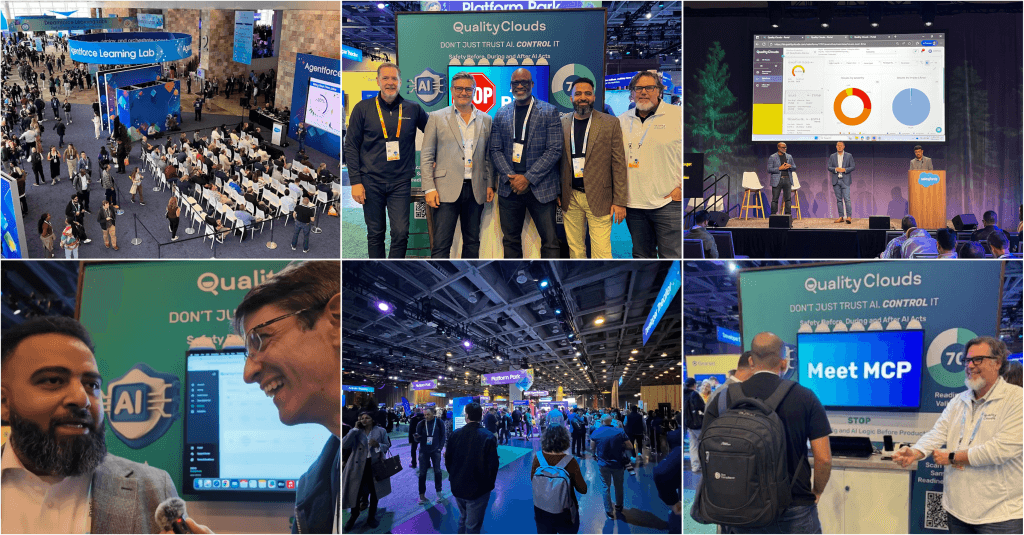
Having just returned from Dreamforce 2025, the team at Quality Clouds is energized by the innovation, energy, and collaboration that defined this year’s event.
Our presence, both at the booth and on stage, aligned perfectly with our mission: to help enterprises build safely and confidently, enforcing governance and quality for every line of logic, whether written by a developer or generated by AI.
Below are the core technical themes that stood out, and how they connect to the evolving conversation around AI-driven development.
From AI Experimentation to Enterprise-Grade Adoption
A defining theme at Dreamforce 2025 was the transition from trying AI to operationalizing it responsibly across the enterprise. Organizations are moving past the question of whether AI can help them build faster, and are now asking how to do so safely, visibly, and at scale.
The conversations were not about limiting AI but about enabling it to reach production-grade reliability. This is precisely where Quality Clouds plays a critical role: enabling teams to build with AI confidently by enforcing real-time quality and governance—without slowing innovation.
Agentforce 360 (launched by Salesforce at Dreamforce) showed how Salesforce is embedding governance, observability, and security directly into its new AI architecture. It’s a clear recognition that as AI agents begin to act autonomously, enterprises need structured governance frameworks that ensure every AI action is auditable, traceable, and policy-aligned.
That is exactly the space Quality Clouds occupies, bringing this same principle of governance as an enabler of scale to every platform, from Salesforce and ServiceNow to modern dev environments.
For readers interested in exploring session material:
The official session catalogue for Dreamforce 2025 can be found here
The on-demand streaming of keynotes and sessions is available on Salesforce+ here
The Rise of Vibe Coding in the Salesforce Ecosystem
One of the standout innovations this year was Vibe Coding, launched through the Agentforce Vibes platform.
Unlike earlier copilot tools, Vibe Coding allows developers and admins to describe functionality in natural language, and then have AI generate, test, and deploy secure code and components, all within the enterprise’s governance boundaries.
This launch also signals a strategic acceleration from Salesforce. Much like ServiceNow’s Now Assist Build Agent, Salesforce had to move fast into the AI-native development world. The pressure is real: emerging players such as Replit and Lovable are redefining what a modern, AI-first development experience feels like.
However, Salesforce and ServiceNow hold a decisive advantage that those newcomers don’t, they own the business data context.
That means their Vibe Coding and Build Agent frameworks can generate logic that’s not only syntactically correct, but also semantically aware of enterprise data, metadata, and policy relationships.
It’s this combination, AI-driven speed plus contextual intelligence, that positions the established platforms to remain dominant, provided they continue to embed governance, explainability, and traceability into their development fabric.
Key Takeaways
From prompt to production: The AI agent “Vibe Codey” can generate and validate code directly against org metadata and policies, applying built-in tests and compliance checks before deployment.
Empowering analysts and admins: Non-developers can now shape apps and workflows more independently, with real-time feedback that ensures security and maintainability.
Enterprise-grade governance: Integration with DevOps Center, Sandboxes, and the Security Trust Layer allows organizations to maintain full visibility and auditability of all AI-generated logic—precisely the approach Quality Clouds extends across platforms.
This evolution doesn’t replace developers. Instead, it amplifies them, freeing technical teams from repetitive coding so they can focus on complex architecture, integrations, and value-driven engineering.
Read more about Vibe Coding and how Salesforce describes it here
Building the Agentic Enterprise
Another major narrative from Dreamforce was the Agentic Enterprise, a model where AI agents act as intelligent collaborators across teams, automating workflows while operating within clear governance frameworks.
With Agentforce 360, Salesforce is redefining how these autonomous agents operate across business domains. Each AI agent is empowered to act, but always under observable, governable boundaries.
As these agents begin writing logic, generating flows, and invoking APIs, ensuring consistency, security, and traceability becomes critical. Here again, Salesforce’s vision aligns with Quality Clouds’ mission: AI and human logic must follow the same governance and quality standards.
Organizations that can embed policy enforcement and quality assurance into the creation process, not after deployment, will be the ones that scale AI successfully, safely, and sustainably.
Data 360 and the Unified Metadata Catalog
Salesforce’s rebranding of Data Cloud into Data 360, and the launch of its Unified Metadata Catalog, represent a foundational step toward AI governance by design.
With the ability to query and understand all metadata, including AI-generated logic, through natural language, architects can finally trace how data, prompts, and automation connect across the enterprise.
This unified visibility across code, configuration, and AI output is exactly the kind of context that Quality Clouds’ governance layer provides for ServiceNow, Salesforce, and modern dev environments.
Governance isn’t just a compliance need, it’s what allows AI to remain explainable, maintainable, and safe in fast-moving environments
Governance starts where AI code begins.
Scan Copilot or Claude output before it hits Git.
Final Thoughts
Dreamforce 2025 made one thing clear:
AI is no longer an experiment, it’s an engineering discipline.
To scale AI safely, organizations must automate governance with the same rigor they apply to delivery pipelines. The enterprises that thrive will be those that can move fast and stay in control, balancing innovation with confidence.
At Quality Clouds, we’re proud to be part of that journey, helping enterprises integrate AI into their development processes with real-time visibility, enforceable policies, and platform-native control.
Stay tuned for our upcoming technical deep dives inspired by Dreamforce 2025, where we’ll explore Vibe Coding, Agentforce 360, and the new era of governed AI development.