Article
Nov 11, 2025
Governance has moved. See how platform-first enforcement keeps your org compliant as logic is created across Salesforce, ServiceNow, and AI tools.
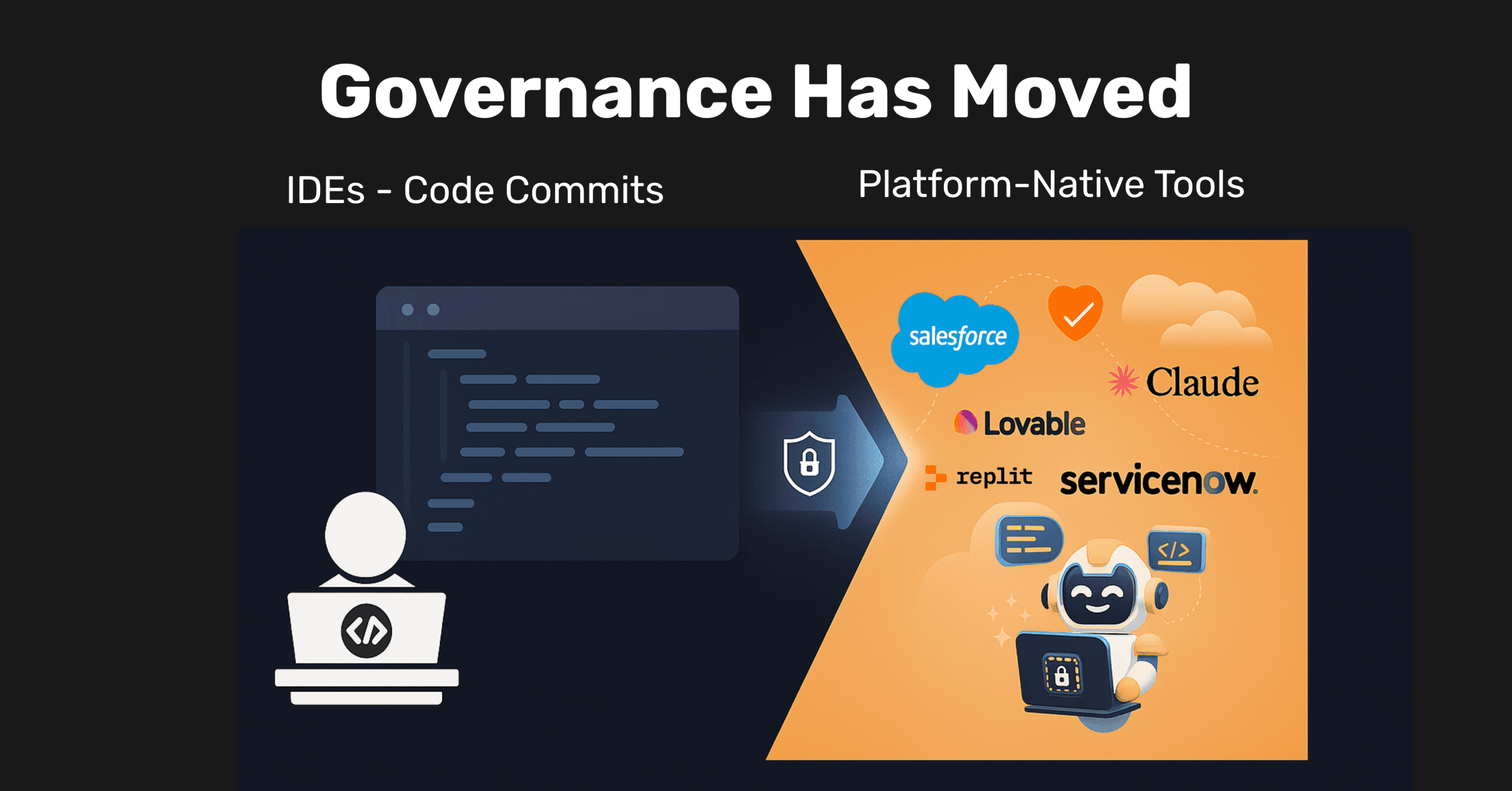
As AI becomes a core part of the modern SDLC, logic isn’t just written — it’s generated. It’s assembled inside enterprise platforms and composed by assistants like GitHub Copilot, Claude, Salesforce Agentforce Vibes, or ServiceNow’s Agent Builder. And this changes everything about where — and how — governance needs to happen.
Most enterprise code governance tools still operate under a pre-AI assumption: that logic is written by humans in traditional IDEs and committed through Git workflows or other packaging methods. Rules are enforced at pull request, static scans happen post-commit, and governance acts as a gatekeeper between environments.
But that’s no longer enough.
Logic Isn’t Just in Code Anymore
In an AI-native SDLC, business logic is increasingly authored inside platforms, not files:
Salesforce: Vibes agents, Flow AI, Copilot completions.
ServiceNow: Flow Designer, Build Agent, Now Assist output.
Replit, Claude, Lovable: AI-native dev environments where “save” doesn’t mean “commit”.
Much of this logic never touches Git, and often bypasses the traditional SDLC entirely, no version control, no peer review, no structured promotion path. And even when AI-generated logic is committed to Git, traditional CI/CD pipelines are blind to its origin, intent, and risk profile. They weren’t designed to parse prompts, flows, or agent output, and they certainly weren’t built to govern probabilistic code.
Why IDE-Centric Governance Falls Short
Let’s examine the assumptions baked into conventional tools:
Assumption | Reality in AI-Native Dev |
|---|---|
Code is created in IDEs | Code is generated inside platforms and builders |
Devs write logic manually | AI and low-code agents generate logic autonomously |
Git is the single source | Many logic surfaces never hit Git or only partially |
Static checks post-commit | Risk needs to be caught at creation |
The problem isn’t just coverage, it’s timing. Post-facto tools react after the code already exists. They can’t enforce guardrails where AI is actively writing or modifying logic.
Why Platform-First Governance Is Necessary
Governing AI-native platforms means treating all surfaces of logic creation — not just code — as enforceable entry points:
Flows, bots, scripts, prompts, metadata, generated agents — all of them must be governed like code.
Policy enforcement must happen at the moment of creation, not after code hits version control.
Visibility must include who created what, even if that “who” is an AI assistant.
Unlike tools that detect after the fact, Quality Clouds enforces policy as logic is being created — whether it’s a Copilot suggestion, a Flow AI configuration, or a ServiceNow prompt. This is real-time, deterministic governance embedded directly into platform workflows.
Consider ServiceNow
Consider ServiceNow’s new AI builders.
A developer — or even a platform analyst — uses Now Assist to extend a flow or script in Studio. That logic lives inside the platform immediately. Yes, it may be bundled into an Update Set — but:
Was the prompt reviewed?
Was the generated logic compliant with internal patterns?
Is there any trace that AI authored it?
Most organizations today have some SDLC controls in place, Update Sets, approval workflows, maybe even integration with DevOps Center. But none of those tools were built with AI in mind. They track objects, not intent. They promote logic, not policy compliance.
This is the governance gap: AI-generated logic may technically follow the promotion path, while violating the rules you’re trying to enforce.
Quality Clouds integrates natively with ServiceNow to govern logic created by AI, including inside tools like Build Agent, Now Assist Agent Studio, and Flow Designer.
Governance starts where AI code begins.
Scan Copilot or Claude output before it hits Git.
We embed policy enforcement directly into the generation layer, guiding AI assistants to produce logic that complies with enterprise standards from the start.
This includes enforcing sanctioned configurations, architectural patterns, access controls, and naming conventions, not after code is written, but as it’s being composed.
These real-time checks are surfaced in platform-native experiences, and violations can be routed into governance systems like the AI Control Tower or DevOps pipelines.
This isn’t just theory, we’re already catching ServiceNow AI-generated logic with security misconfigurations, excessive permissions, and untracked changes.
Example: LivecheckAI and Agent Builders in Action
Let’s take ServiceNow as a concrete example:
A developer — or platform analyst — uses Build Agent to create a new workflow or logic block. As the assistant suggests logic, LivecheckAI is already at work in the background:
Enforcing your organizations platform rules in real time, so that only compliant patterns are accepted
Shaping the AI output — nudging the assistant toward secure, scalable, policy-aligned logic
Logging AI-generated logic as first-class citizens in your SDLC — including metadata, risk scores, and violations
Even if this logic is added to an Update Set or promoted via standard workflows, your governance begins at the moment of generation. Not after. But directly inside the ServiceNow platform, where AI now writes the logic.
Developers Want Speed — But Enterprises Need Control
Let’s be clear: developers don’t want friction. And platform governance shouldn’t slow them down. That’s why governance needs to be:
Inline: Flag issues where logic is created.
Explainable: Show why a policy was violated and how to fix it.
Automated: Offer safe auto-fixes or block commits only when necessary.
Done right, platform-first governance becomes a force multiplier — accelerating safe delivery, not hindering it.
Closing Thought: It’s Time to Rethink Where the SDLC Begins
Governance starts where the code begins.
AI coding isn’t just faster — it’s structurally different. If your governance framework assumes humans in IDEs pushing to Git, you’re flying blind.
It’s time to govern where the logic lives: inside the platform, inside the flow, inside the agent.
The SDLC has moved. Your governance needs to move with it.
Explore how LivecheckAI keeps your logic compliant, in real time.