
As Salesforce DevOps fully transitions to a modern, Git-native, and AI-accelerated stack, traditional post-release audits can no longer keep up with the speed of development. Discover why native AI Code Governance is essential to secure your pipeline, maintain compliance, and safely scale AI-generated code directly inside your modern DevOps workflow.
Salesforce
DevOps & CI/CO
AI Code Governance


In May 2026, Copado closed the door on new Metadata format pipelines. The decision is small in technical terms and large in what it signals. Salesforce DevOps has finished its transition to a modern, Git-native, AI-accelerated stack. AI Code Governance has to operate inside that stack, not alongside it.
The new Salesforce delivery stack
The Salesforce DevOps stack that enterprises run today looks nothing like the one they ran five years ago. Four things have changed in parallel, and the combined effect is greater than any one of them.
Source Format (DX) is the standard. Granular metadata, modular packaging, clean mapping to Git. The shape of the codebase is structurally different.
Git is the source of truth. Pull requests, branch strategies, merge gates. Salesforce code now flows through the same review processes as the rest of the engineering organisation.
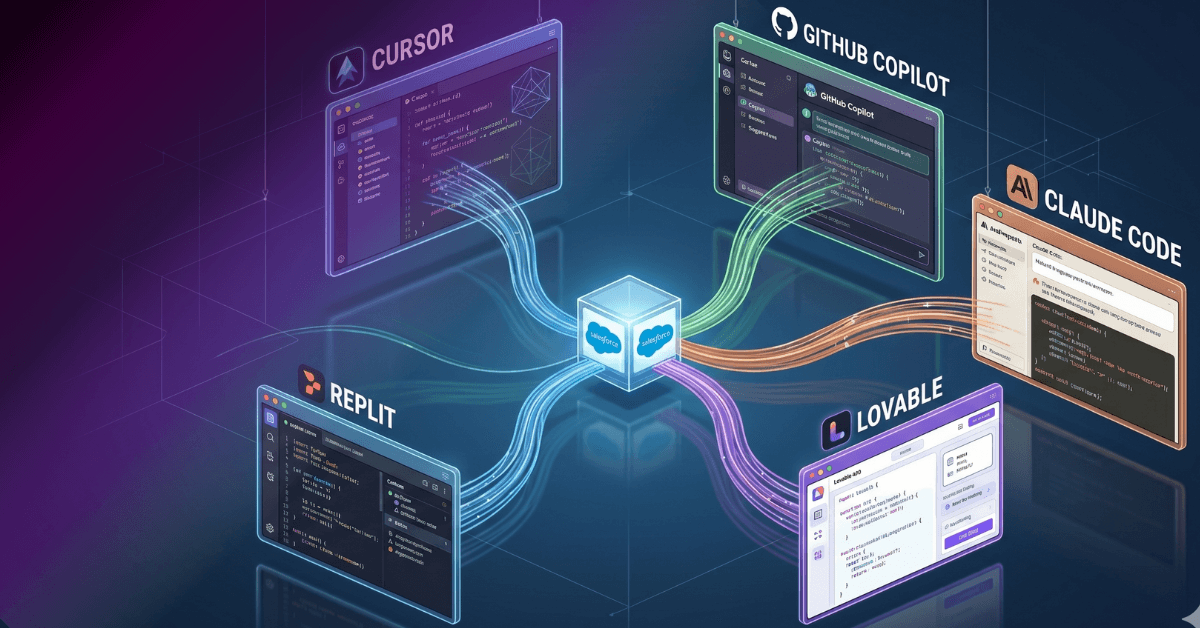
AI assistants accelerate development. Cursor, GitHub Copilot, Claude Code and Agentforce builders generate Apex, Lightning Web Components and configuration changes at volumes that would have been impossible a few years ago.
DevOps platforms orchestrate everything. Copado, Gearset, Flosum and others sit at the centre of release flow, with their own embedded checks, approvals, and policies.
Each of these is positive for productivity. Together, they create a governance problem that the previous generation of tools cannot solve.
Why bolted-on governance breaks
The previous generation of Salesforce quality tools worked as periodic audits. Run a scan at the end of the sprint. Export a report. Triage findings in a separate system. Push fixes through the next release cycle. That model assumes code moves slowly enough for the audit cadence to catch up.
Three forces have broken that assumption.
AI assistants produce more code in an afternoon than a developer used to write in a week. By the time the next audit runs, the codebase has moved on. DX format means changes are smaller and more frequent — the pipeline runs more often, the window between code being written and code reaching production has shrunk. And DevOps platforms expect to make release decisions in real time; a governance tool that responds in days cannot inform a gate that decides in minutes.
The result is a widening gap between what teams ship and what governance covers. Audits become trailing indicators. Production becomes the place where governance findings are discovered, rather than the place where governance failures are prevented.
CHECKLIST
Is Your Salesforce Ready for AI Code?
AI agents now have live write access to production. Download the 12-point blueprint to secure your pipeline before they touch your metadata

What native AI Code Governance looks like
Native governance is governance that lives where the code lives. It runs inside the IDE the developer is using. It runs inside the pipeline the DevOps platform is orchestrating. It runs against the same rules that audit will measure against, so there is no gap between what developers ship and what auditors review.
In practice, native AI Code Governance has five characteristics.
First, inline validation. Every change is checked in real time against the organisation's rules. LivecheckAI provides this layer for Salesforce, including for code generated by AI assistants — the same controls apply whether a human or a tool wrote the change.
Second, pipeline gating. Quality Gates apply at every promotion step inside the DevOps platform. The pipeline advances changes that meet policy and blocks the ones that do not. Findings surface at the gate, not in a separate dashboard discovered weeks later.
Third, rule portability. AI Rule Builder lets platform teams encode organisation-specific governance — naming conventions, sharing rules, profile boundaries, sector-specific controls — once. The same rules apply across IDE, pipeline, and audit baseline.
Fourth, full-estate visibility. Full Scan establishes a continuous view of every org in scope. Governance teams see what has changed, what has drifted, and what needs attention without waiting for the next audit cycle.
Fifth, native DevOps integration. The governance layer plugs directly into the DevOps platform. Developers do not switch tools. Governance teams do not reconcile reports from disconnected systems. Auditors do not assemble evidence from a dozen places.
When these five characteristics are in place, governance stops being a brake on delivery and becomes part of the flow.
Master the Vibe Coding Era
Don't let AI-generated velocity break your release gates. Instantly secure your pipeline with Quality Clouds' native governance engine
What this means for platform leaders
For CTOs, CISOs and Salesforce platform architects, the implications are practical.
Procurement assumptions need to update. Governance tools chosen for the Metadata era may not have followed the platform through DX, Git-native delivery, and AI-assisted development. The right question is no longer whether a tool finds defects. The right question is whether the tool governs the same code that the DevOps platform is shipping, in the same window, against the same rules.
Compliance evidence needs to update. Auditors increasingly want continuous evidence, not sample-based snapshots. SOC 2, ISO 27001, DORA, and the EU AI Act each favour organisations that can demonstrate governance was applied in line with development, not retrospectively. A native AI Code Governance layer produces that evidence as a by-product of normal operation.
AI adoption needs governance to scale with it. Boards are asking platform teams how they govern AI-generated code. Manual review scales to a few developers, not to an organisation deploying Cursor or Claude Code across hundreds. Native AI Code Governance is the mechanism that lets enterprises adopt AI development tools without losing oversight.
Operating model needs to update. Governance teams and platform teams have often run on separate cadences — one shipping releases, the other reviewing them after the fact. Native AI Code Governance puts both teams on the same timeline. Platform engineers and security architects see the same findings, in the same window, against the same rules. The work of governance moves earlier in the lifecycle, and the friction between delivery and oversight narrows.
The direction is fixed
Copado's move to mandatory Source Format (DX) is one signal among many. Salesforce will continue to invest in DX. The other DevOps platforms will follow. AI assistants will become more capable, not less. The shape of Salesforce DevOps is set.
The organisations that come through this period strongest will be the ones who treat governance as part of the stack, not as an external check on it. Native AI Code Governance is the discipline that makes that work. It is what lets a CTO say, with evidence, that the code reaching production was governed at the moment it was written — regardless of who wrote it, which tool generated it, or which DevOps platform shipped it.
This is what AI Code Governance is for. Production-Ready AI Code is the result.
Frequently Asked Questions

Javier Luesma
Product Lead, Quality Clouds
Related articles
Stay ahead of the curve

AI Code Governance
Security & Compliance
Satya Nadella's Learning Loop: Why AI Code Governance Is the Enterprise Survival Layer

Albert Franquesa
5 min read
Why Microsoft CEO Satya Nadella says picking the best AI model isn't enough—and how to build a proprietary loop that protects your enterprise value
AI Code Governance
DevOps & CI/CO
10 Best Practices for AI Code Governance in Multi-Developer Teams

Cristian Urraca
6 min read
Discover the 10 essential guardrails for managing multi-developer AI engineering teams
AI Code Governance
Event & Insights
Why a Code Governance Company Sponsors a Social-Impact Hackathon

Mariona Valero
6 min read
We brought AI code governance to a 36-hour hackathon in Barcelona, and the results speak for themselves