AI
Apr 17, 2025
AI for Enterprise DevOps: Distinguishing AI Agents, Chatbots & Copilots
Learn how enterprise AI tools like chatbots, copilots, and autonomous agents differ, where each fits in your SaaS AI journey, and how to adopt them safely and effectively in complex environments like Salesforce and ServiceNow. This guide helps IT leaders and platform admins understand capabilities and risks as AI adoption scales across the enterprise.
By 2026, more than 50% of enterprise AI investments will move from experimentation to full-scale deployment. But what does that really mean for SaaS platform owners, enterprise architects, and platform admins?
If you’re navigating the complexity of secure, scalable AI adoption across tools like Salesforce or ServiceNow—while trying to maintain platform stability and governance—this blog is for you.
You’ll learn:
How to differentiate between chatbots, copilots, and autonomous AI agents
Where each fits into the SaaS AI maturity journey
Real examples of how tools like Quality Clouds Copilot help teams adopt AI safely and effectively
What’s coming next in enterprise-grade AI, including agentic systems
Whether you’re an IT leader assessing new investments or a platform admin looking to integrate AI without losing control, this post will help you understand the roadmap, and avoid the risks of enterprise AI in 2025.
Ready to see how AI can safely scale your SaaS platform?
Talk to an AI adoption expert at Quality Clouds and get a free walkthrough of how QC Copilot can enhance productivity, reduce platform risk, and support your governance strategy across Salesforce and ServiceNow.
Request Your Free QC Copilot Demo Now
The AI Adoption Dilemma in SaaS Platforms
The speed at which AI tools and models are emerging has the potential to transform businesses, but also presents challenges due to the uncertainties around risks associated with uncontrolled adoption.
Furthermore, SaaS platform users are already facing challenges in empowering citizen developers to contribute effectively to platform functionalities. They must ensure these contributions do not compromise essential non-functional requirements like security, performance, and manageability.
The combination of these two trends can, if not properly managed, create a perfect storm in which the possible risks multiply exponentially. Can we trust citizen developers to generate sophisticated code elements, which they only partially understand, if at all, with the aid of AI? Will an AI code generator optimize for a particular problem without taking into account the overall stability and maintainability of the platform? Will the quantity of AI-generated changes overwhelm the ability of platform owners to manage and supervise the changes being deployed into production environments?
At Quality Clouds we believe that providing SaaS companies with a set of controlled, curated and validated AI-powered solutions can lower these barriers to entry and allow our customers to leverage the AI capabilities to full effect in a safe and controlled manner.
Why Definitions Matter: Chatbots vs Copilots vs AI Agents
Specifically in the context of SaaS Platforms, the adoption of AI-assisted functionalities can take many forms. In order to provide some context, it is useful to classify the different types of adoption mechanisms in an evolving scale of complexity and capabilities.
AI Chatbots: Pioneers in Automated Interaction
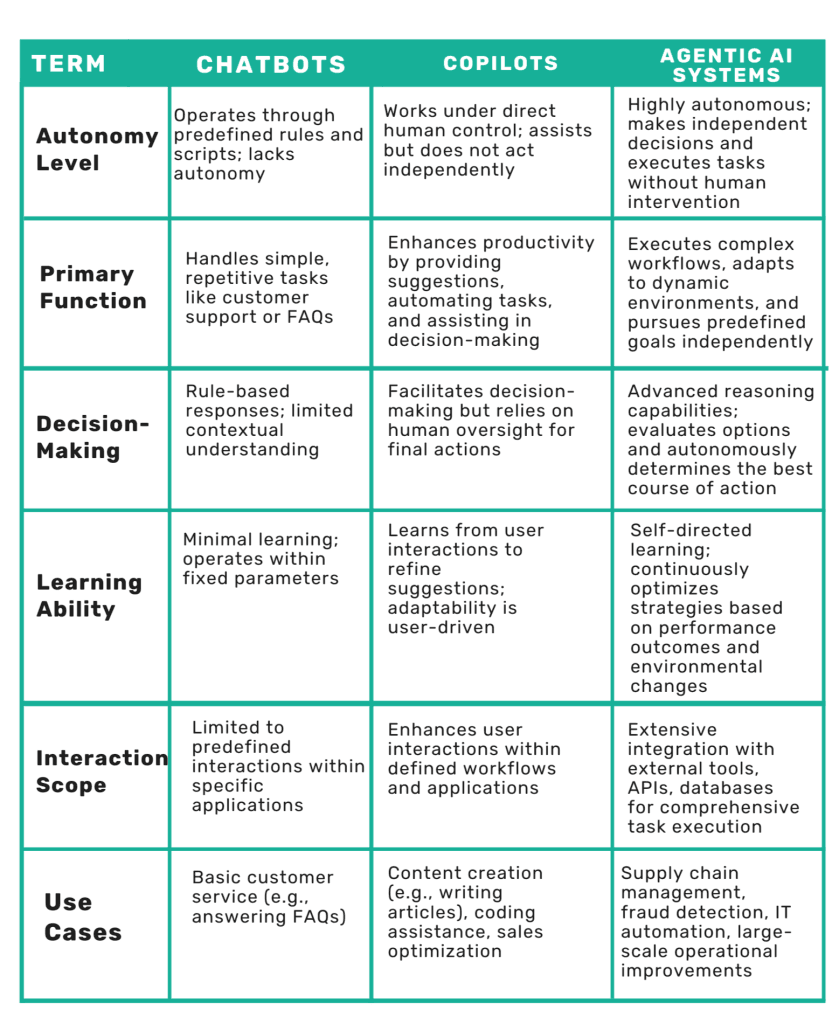
Chatbots are rule-based systems designed for structured, repetitive interactions. Operating through decision trees or keyword matching, they excel at handling high-volume, low-complexity tasks like answering FAQs or processing standard requests. For instance, a retail chatbot might resolve queries about store hours or return policies without human intervention.
Companies started adopting the simplest types of chatbots as early as the 1980’s. Their capabilities evolved with the introduction of more sophisticated Natural Language Processing and Machine Learning techniques. While it is now possible to integrate backing Large Language Models (LLMs) which the chatbots can leverage (for instance, to extract the intent behind user input through an LLM, rather than through pattern matching), the defining characteristics of a chatbot are that its scope for action is limited to a specific use case, and that its ability to interact with external systems is limited or non-existent.
AI Copilots: Enhancing Human Expertise
Copilots represent a leap in human-AI collaboration. Unlike chatbots, these systems, backed by Large Language Models (LLMs), provide context-aware assistance in specialized domains. GitHub Copilot, for example, suggests code completions by analyzing a developer’s existing work and broader project context.
Crucially, copilots maintain a “human-in-the-loop” architecture—they enhance rather than replace expert judgment. This balances automation with accountability, making them particularly valuable in regulated industries.
The first AI powered tool Quality Clouds offered by Quality Clouds is Quality Clouds Copilot. Copilot is tightly integrated with the LiveCheck (™) functionality, which helps ensure that code built for ServiceNow and Salesforce complies with platform best practices. After issues have been identified, Copilot will suggest fixes to the code, based on a curated library of design patterns to implement fixes in the most optimal way possible.
Because this is a tightly controlled use case, where developers are not allowed to enter free-form prompts, the potential for unwanted side effects is eliminated. Further, no code is automatically applied to the platform, and all the AI-generated suggestions are stored in the platform, which gives senior developers or architects the opportunity to review and accept changes if required. In addition, each recommendation generated by Copilot can be rated on a one to five scale. The higher-rated recommendations can then be used as examples for further Copilot interactions, which allows the system to tailor the recommendations to each customer’s preferences.
AI Agents: Autonomous Enterprise Problem-Solvers
AI agents operate at the highest level of sophistication. These systems are integrated into their environment through data and / or event streams, and can generate sophisticated responses to manual user inputs. Additionally, they possess the ability to interact and collaborate amongst themselves, and to execute actions through integrated APIs.
How QC Copilot Brings Safe, Scalable AI to Life
The next steps in the Quality Clouds AI-powered offering will be agentic systems. Always with the approach of making the integration of AI capabilities safe, secure and controllable by customers. There are three directions where we see Agentic Systems as providing clear value in this context:
Support Agents – These agents will be able to combine Retrieval Assisted Generation techniques with the appropriate use of tools (always with end user opt-in) to determine the root cause of issues which may arise during the use of the Quality Clouds ServiceNow and Salesforce apps, as well as the admin portal and dashboards. Whenever appropriate, automated remediation actions may be taken to allow self-service issue resolution. If that is not possible, automated ticket creation with a record of the conversation should reduce issue fix times.
Self-service rule builder – These agents will collaborate to support Quality Clouds customers in the implementation, testing and deployment of custom rules. They will have access to instance data and to the Quality Clouds rule engine API to allow online testing of rules as they are being built, with the ability to refine them until the expected results are achieved. Then, automatic rule publishing will be supported in order to remove the dependency on Quality Clouds support to implement these custom rules.
Data Analysis – These agents will be able to provide specific, actionable insights based on the results of the Quality Clouds Analysis engine. Supported by platform-specific knowledge, and able to provide a holistic view at all scales of functional scope (from application to platform feature to the whole SaaS instance configuration), the agents will collaborate to produce sophisticated data analysis reports.
Exploring AI for your platform? Quality Clouds helps you adopt copilots and agentic systems safely—with full control and governance. Ask us how.
What You’ve Learned & Where to Go From Here
The rapid evolution of AI technologies presents both opportunities and challenges for SaaS platforms, particularly in ensuring secure and effective adoption. By distinguishing between Chatbots, Copilots, and Agentic AI Systems, businesses can better understand the capabilities and limitations of each approach, enabling them to make informed decisions about integrating AI into their workflows.
Ready to Take Control of Your Platform Governance?
Next Steps
At Quality Clouds, we are committed to empowering SaaS companies with controlled, curated, and validated AI-powered solutions. From enhancing productivity with copilots to exploring the transformative potential of agentic systems, our focus remains on delivering safe and scalable innovations. By leveraging AI responsibly, organizations can unlock new efficiencies, streamline operations, and foster collaboration while maintaining the stability and security of their platforms.
As we look to the future, the integration of agentic systems promises to redefine enterprise problem-solving by automating complex workflows, enabling self-service capabilities, and delivering actionable insights. Together, these advancements will help SaaS platforms navigate the complexities of AI adoption while maximizing its benefits. The journey toward smarter, safer AI begins with understanding its role—and Quality Clouds is here to guide you every step of the way.
Learn how QC Copilot can help your enterprise scale AI. Book a demo today.