
This blog explains why traditional linters aren’t enough to ensure true platform health in ServiceNow and other SaaS environments. Readers will learn how Quality Clouds goes beyond syntax checks by analyzing configurations, integrations, security, and governance. It also shows how Quality Center and QC Copilot support both developers and Citizen Developers with real-time, platform-aware guidance.



What is platform health in the context of ServiceNow?
Chris Riggs, Senior Product Manager at Quality Clouds, says that the best way to think about platform health is to first understand what we mean by platform unhealthiness.
“People are trying to keep their platform in a state such that there are no symptoms that might affect their ability to use the platform at a successful rate. If there are performance issues, security breaches, or they aren’t able to make as many changes as they used to because they’re having to test a lot — these would all be symptoms that a platform is becoming unhealthy.”
Ultimately, platform health is all about maintaining a well-optimized, secure, and scalable system. The goal is to support continual improvement and efficient operation in ServiceNow without introducing operational vulnerabilities or inefficiencies.
What is a Linter?
Before diving into the unique role of Quality Clouds, it’s important to understand what a linter does. Linters are tools used primarily by developers to analyze code for syntax errors, coding standards violations, and stylistic inconsistencies. By identifying potential problems as code is being written, linters help ensure a cleaner, more efficient codebase. They provide real-time feedback during the development process, preventing bugs or performance issues from creeping in at a later stage.
However, traditional linters are limited in scope. They are designed to handle code at the syntax level, looking for mistakes or inconsistencies in the structure of the code rather than offering insight into larger architectural or governance issues. For platforms like Salesforce, ServiceNow, and Microsoft Dynamics 365—where configurations, integrations, and security policies are just as important as the code itself—organizations need a solution that goes further.
Quality Clouds: Beyond Traditional Linters
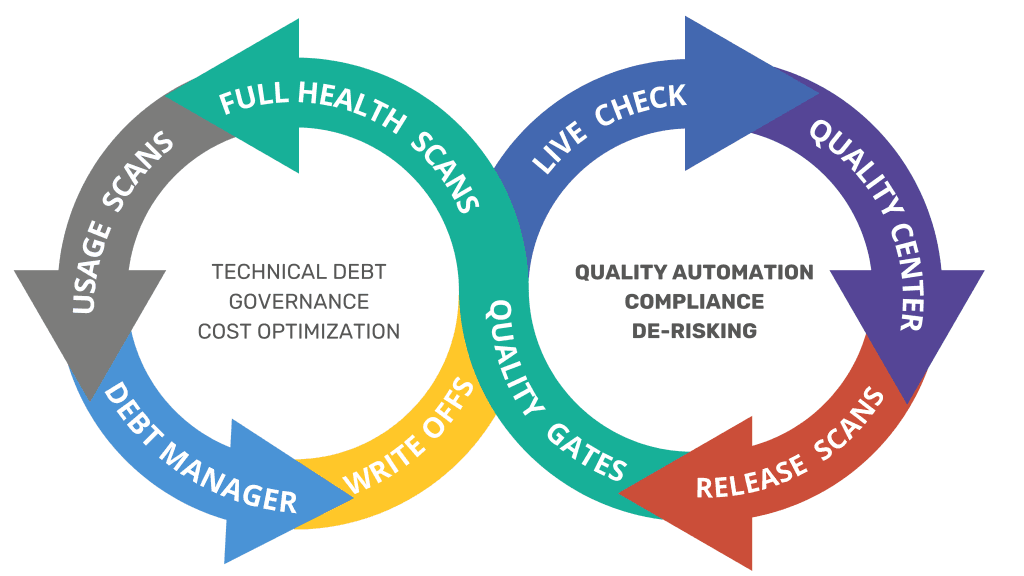
With Quality Clouds, developers can access code and configuration checks via our apps and APIs, allowing them to build faster while simultaneously improving their skills. The platform acts as an assisted “teacher,” guiding developers by offering real-time feedback and recommendations. This continuous learning process helps developers become more proficient as they code.
Furthermore, Quality Clouds checks consider both the code generated by a developer and the SaaS-specific context on which the code will run. For example, is the code server-side or client-side? Will it execute under specific business conditions, or will it run continuously? These contextual nuances are crucial in SaaS environments, as the execution and performance of code depend heavily on its interaction with platform metadata and configurations. Traditional linters are unable to capture these nuances because they analyze code in isolation. Quality Clouds, however, is aware of both the code itself and all the SaaS-specific metadata that surrounds it, allowing for a more comprehensive and relevant analysis.
Additionally, with QC Copilot, developers can not only check their code but also automatically receive and review suggested fixes. By accepting these improvements, they can immediately implement best practices, speeding up development while ensuring high-quality standards. This combination of automation and guided learning helps developers enhance their productivity, reduce errors, and accelerate development cycles across SaaS platforms such as Salesforce, ServiceNow, and Microsoft Dynamics 365.
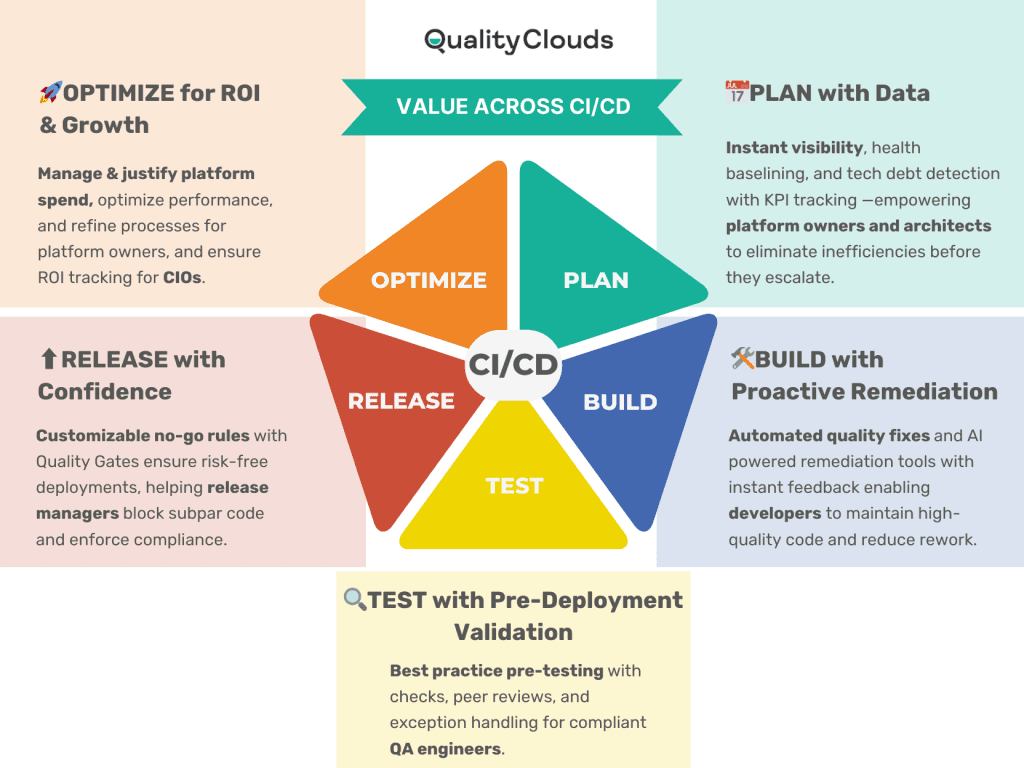
In large-scale SaaS environments, code is just one piece of the puzzle. There are also platform configurations, integrations, security settings, and governance rules that need to be considered. While a linter can help individual developers catch errors as they write code, Quality Clouds is designed to give you visibility into the entire system, from code quality to configuration integrity. It is a proactive tool that ensures organizations:
Reduce technical debt: By continuously scanning for inefficiencies and redundant code.
Enhance security: Identifying vulnerabilities in your code and configuration that could expose the organization to risks.
Ensure platform compliance: Especially important in regulated industries like finance, healthcare, or government, where data privacy and operational consistency are non-negotiable.
This broader approach allows organizations to monitor the quality of their entire platform rather than just focusing on code syntax.
Supporting Citizen Developers in the Low-Code/No-Code Era
With the rise of Citizen Development, where non-professional developers can create applications on SaaS platforms, maintaining code and configuration quality becomes an even greater challenge. Without the rigorous training of professional developers, Citizen Developers are more likely to introduce inefficiencies, errors, or security risks into the system.
Quality Clouds’ new Quality Center addresses this challenge by offering real-time code and configuration checks, allowing Citizen Developers to validate their work as they build. This proactive approach helps ensure that even non-technical users adhere to coding best practices and maintain the integrity of the platform.
In addition to supporting Citizen Developers directly, Quality Center helps organizations:
Monitor quality across all developers, including Citizen Developers, by providing a consistent framework for validating code and configurations.
Enforce governance: Quality Center helps to adhere to Governance, Risk, and Compliance (GRC) best practices into the Software Development Lifecycle (SDLC). It ensures that development adheres to organizational best practices and security policies, minimizing the risk of non-compliance in regulated industries.
Provide insights to improve: By offering recommendations and best practice guidelines tailored to specific platforms, Quality Center enables Citizen Developers to produce better applications while learning industry standards.
Improve time to market: With automated code and configuration checks embedded into the development process, businesses can release high-quality applications faster, as inefficiencies and errors are identified and resolved in real time.
Conclusion
Adding GRC concepts to the SDLC through Quality Clouds provides several benefits, including:
Reduced risk: Continuous checks ensure that applications meet regulatory and compliance standards from the start, avoiding costly fixes later.
Streamlined audits: Automatically tracking compliance throughout the development process simplifies the audit process, reducing administrative overhead.
Consistent quality: Embedding governance and risk controls into the SDLC helps ensure all applications—whether built by professional or Citizen Developers, are secure, efficient, and scalable.
While linters play a critical role in catching coding errors early in the development process, they fall short in addressing the broader challenges of platform governance, security, and long-term scalability—especially in complex SaaS environments. Quality Clouds fills this gap by offering a comprehensive solution that goes beyond simple syntax checks, providing detailed insights into code, configurations, and platform usage.
For organizations using Salesforce, ServiceNow, or Microsoft Dynamics 365, Quality Clouds is an indispensable tool for maintaining high standards of quality, reducing technical debt, and supporting the emerging world of Citizen Development. In a landscape where the efficiency, security, and compliance of your SaaS platforms can directly impact your business’s success, relying solely on a linter just isn’t enough.
For more insights on DevOps trends and strategies for improving your development process, subscribe to our newsletter.
Stay updated on the latest practices and innovations in ServiceNow and Salesforce DevOps.

Albert Franquesa
Co-Founder & CSO, Quality Clouds
Related articles
Stay ahead of the curve

What Is AI Code Governance?
Albert Franquesa
10 min read
The goal is trust: know what goes into production and be able to prove it. The six guarantees AI code governance has to deliver.

How do I build thee (with AI)? Let me count the ways

Ignacio Sales
11 min read
Seven ways to build on ServiceNow with AI, three places the code lands, and where Quality Clouds for ServiceNow checks each one.

ServiceNow and GitHub: how to govern pull requests when your apps move to source control

Taher Dohadwala
6 min read
ServiceNow source control works per application and the diff is XML. Here's what that means for pull requests, update sets, and where to put the gate.